
World Cricket
Conway Concussion Deepens New Zealand's Injury Woes Ahead of India ODI Series Opener
मुख्य तथ्य: न्यूजीलैंड के सलामी बल्लेबाज डेवोन कॉनवे को ईडन पार्क में अभ्यास के दौरान फील्डिंग सत्र में मैट हेनरी से टकराने के बाद कन्कशन की पुष्टि हुई है और वे भारत के खिलाफ सीरीज के पहले वनडे में नहीं खेलेंगे। दोनों खिलाड़ियों का हेड इंजरी असेसमेंट हुआ, अस्पताल में जांच के बाद कॉनवे का कन्कशन पुष्ट हुआ और न्यूजीलैंड क्रिकेट दोनों की निगरानी जारी रखे हुए है। हेनरी की उपलब्धता पर अंतिम फैसला लंबित है। कॉनवे की अनुपस्थिति उस टीम में जुड़ रही है जो पहले ही रचिन रवींद्र और मार्क चैपमैन को खो चुकी है, यानी शीर्ष और मध्यक्रम के तीन बल्लेबाज एक साथ बाहर हैं। कॉनवे बाएं हाथ के शीर्ष क्रम के बल्लेबाज हैं, इसलिए यह रणनीतिक नुकसान है, केवल आंकड़ों का नहीं। घटना गैर-संपर्क दुर्घटना है, इसलिए इसे फिटनेस या वर्कलोड प्रणाली की विफलता नहीं माना जाना चाहिए। कन्कशन की वापसी चरणबद्ध चिकित्सकीय प्रक्रिया से तय होगी, इसलिए पहले वनडे से बाहर होना न्यूनतम अवधि मानें, अधिकतम नहीं। कन्कशन सब्स्टीट्यूट के इस्तेमाल पर बोर्ड का फैसला सबसे महत्वपूर्ण अनुपस्थित विवरण है। ईडन पार्क की छोटी सीमाएं और शाम के स्विंग आंशिक संतुलन दे सकते हैं, लेकिन शीर्ष क्रम के अनुभव की भरपाई नहीं कर सकते।
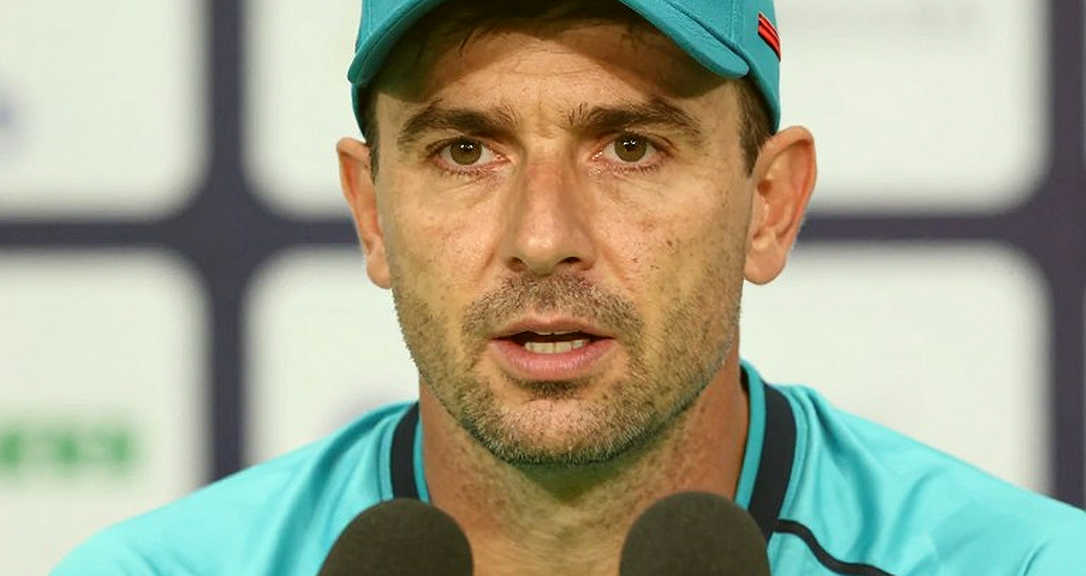
New Zealand cricket is walking into the opening One-Day International of its home series against India in the middle of a deepening availability crisis. Senior opening batter Devon Conway has been confirmed with concussion after colliding with fast bowler Matt Henry during a fielding session at Eden Park in Auckland. New Zealand Cricket confirmed the diagnosis following a hospital examination and said both players would continue to be monitored. The practical consequence is immediate: Conway will not be available for the first ODI, and that absence lands on a side that has already lost Rachin Ravindra and Mark Chapman.
This is not the story of one player missing a match. It is the story of a batting order being hollowed out at three separate levels. Conway is a top-order opener, Ravindra is a top-order batter and Chapman is a middle-order option. Three distinct rungs of the card have shifted at once. The reshuffle therefore cannot be absorbed by a single replacement; the entire batting blueprint has to be rebuilt. What makes it harder for the team management is that the incident carries no signal about workload or conditioning. This was a fielding accident at training, a sudden non-contact event with no predictive value, and it should not be read as evidence of a failing fitness programme.
The sequence is straightforward. Both players were fielding, the collision occurred, and immediate medical care was provided. Both underwent a Head Injury Assessment, the standardised protocol used to detect concussion after head impact. A hospital examination followed, which confirmed Conway's concussion. New Zealand Cricket said monitoring of both players would continue, which also makes clear that Henry's status is not yet settled. The fact that both men were filtered through the same standardised process shows protocol compliance in real time rather than an ad hoc decision.
Conway's absence should be read as a tactical loss, not merely a numerical one. As a left-handed top-order batter, he directly shapes the opposition's new-ball planning. A left-hander changes the angle for bowlers and disrupts plans built around a right-hand-dominant order. In New Zealand's structure he is the link that gives the innings early stability and allows the middle order to play off that platform. In a 50-over format where two new balls are used and wickets lost in the ten-over powerplay cost far more than in T20, losing that batter does not just alter the game three or four overs later — it changes the tempo of the whole innings.
One point must be stated plainly. The available information contains no mention of Conway's recent form or statistics. Claiming that New Zealand have lost an in-form batter would be unsupported. What can be said is that the side has lost a defined role and a batting balance. That distinction matters, because injury news is routinely inflated with emotional inference.
The most sensitive question is how many matches Conway will miss. Once concussion is confirmed, return to play follows a graded process. That process is governed by medical criteria, not batting form or selectorial preference. The announcement that he will miss the first ODI should therefore be treated as a floor, not a ceiling. If symptoms persist, the return can stretch much further and multiple fixtures in the series could be affected.
The third and perhaps most consequential thread is Matt Henry. Henry leads New Zealand's new-ball attack and, in home conditions, has the ability to swing the ball and put pressure on an opposition opening pair. The report states clearly that he remained in selection consideration, meaning no final call had been made on his availability. From a news perspective that is as significant as Conway's confirmed absence. If Henry is also ruled out, New Zealand lose a top-order batter and their primary new-ball weapon at the same time. That double blow would weaken the side even in home conditions, because home advantage rests largely on generating new-ball pressure in helpful conditions.
Eden Park's conditions play a separate role in this equation. The ground is known for its compact dimensions, with short straight and square boundaries that make run-scoring easier, while evening fixtures under lights offer early swing with the new ball. The venue simultaneously offers two contradictory things: short boundaries for batters and early movement for bowlers. That is partial relief for New Zealand, because quick scoring remains possible on a small ground, but the relief is limited. When the top order is depleted, cashing in on short boundaries requires surviving first, and surviving was precisely Conway's job. It should also be noted that the match timing and weather are not available, so no firm conclusion can be drawn about dew or evening swing. The fielding session took place at Eden Park, which suggests the series opener may be staged there, but that should not be treated as official confirmation.
The matchup against India changes against this backdrop. New Zealand's strength has never been star power; it has been collective systemic balance. The side has typically sat in the strong mid-tier of the rankings, and that position is sustained by cohesion rather than individual brilliance. When three batters are removed at once, the test falls precisely on the mechanism that holds the tier position in place. India's bowling, especially new-ball swing, becomes the central tactical axis against a reshuffled top order. Home advantage adds partial counterweight, but it cannot replace the ballast that top-order experience provides.
Governance and rules questions matter here too. With concussion confirmed, the concussion substitute provision may come into play, allowing a like-for-like replacement. This is the single most important detail missing from the report: it does not say whether New Zealand Cricket intends to name a concussion substitute. That decision will directly determine how much sporting impact Conway's absence carries. Two possibilities exist — the call was pending at the time of writing, or the board chose not to use the mechanism. Both are plausible and each means something different. It is worth noting that no rule violation dimension applies: the collision was accidental, so no dangerous-play or code-of-conduct question arises.
The risk picture is clear. The biggest risk is not Conway alone but the interaction of his absence with the pre-existing losses of Ravindra and Chapman and the uncertainty over Henry. Their convergence is the real problem. A second risk is that concussion return-to-play stretches beyond one match. A third is that if an all-rounder or keeper-batter is pushed up the order to cover the batting, the bowling balance may suffer — an unstated secondary risk that selection pressure could expose. On the other side, because the incident was non-contact and non-load, constructing a narrative about schedule pressure or poor workload management would be analytical over-reach.
On public narrative, this case shows a rare convergence. The media framing, presented as a lengthening injury list, matches the facts. A confirmed concussion, two previously announced absences and one pending call combine into a picture with little room for exaggeration. That is why the gap between expectation and reality is small here. The risk lies in attributing the opener's result entirely to injuries while ignoring Eden Park's home conditions and New Zealand's traditional home resilience. Any tendency to mark India down as a straightforward winner should be balanced by the fact that New Zealand have repeatedly outperformed expectations against strong touring sides at home.
From an industry standpoint the impact is negligible. An injury report does not move broadcast rights, capital markets or derivative markets. There is only one indirect yield: audience pull, because an India tour and a series against India draw disproportionately high viewership in the Indian market. But that demand is created by the series itself, not by the injury. Reading any betting or integrity signal into this report would also be wrong, because the cause is transparently accidental.
The agenda for what to watch is specific. First, New Zealand Cricket's next availability release, which will either name a replacement or settle Henry's status. Second, the team sheet at the toss, which will reveal whether the concussion substitute mechanism is invoked. Third, Conway's graded return timeline, which will show whether the impact stays confined to the opener. Fourth, Henry's fitness outcome, which will determine new-ball quality in home swing conditions. Drawing conclusions about the team's true strength before those four signals resolve would be premature. One point bears repeating: this is the story of an accident, not the story of a collapsed fitness system. Preserving that distinction is the condition for getting the analysis right.
संबंधित खिलाड़ी
अनुशंसित
Cricket's Crowded Calendar: Player Workload and the Future of the Game2026-11-02
Shadman Islam's Ankle and Bangladesh's Real Question: Who Faces the New Ball at the Wanderers2026-11-09
GT and DC Discuss Ashutosh Sharma Trade, but the Fast Bowler Will Decide Its Value2026-11-08
You Can't Build a Story From an Empty Shell: The Tale of That Bengaluru Spreadsheet Nobody Filled In2026-11-03
अनुशंसित
Mustafizur Rahman and Melbourne Renegades: The Full Math of the BBL16 Death-Overs Bet2026-11-05
The 41/3 Forensic Trail: India's Christchurch Win Was Not Decided in the Final Over2026-10-25
The Last-Ball Ledger: Ellyse Perry's Platform, Sarah Coyte's Boundary and Brisbane Heat's Unpaid Death Overs2026-10-30
Andre Coley as Interim Coach: The Year and the Reason Missing From the West Indies Women's Appointment2026-11-04
Empty Output from Stage-1: A Data-Integrity Crisis in the Cricket Analysis Pipeline2026-11-01