
Kabaddi Champions League Expands to 10 Teams: ₹5 Crore Auction Pool and India's Changing Kabaddi Market Amid PKL Uncertainty
मुख्य उत्तर: कबड्डी चैंपियंस लीग का दूसरा सीजन आठ से बढ़कर दस फ्रेंचाइजी का होगा। कुल खिलाड़ी ऑक्शन पूल ₹4 करोड़ से बढ़ाकर ₹5 करोड़ किया गया है। 17 अक्टूबर 2026 की नीलामी में अयान लोचब ₹17.4 लाख के साथ सबसे महंगे खिलाड़ी बने। प्रमुख तथ्य: - नई टीमें: झज्जर जगुआर्स और कुरुक्षेत्र नाइट्स। - कुल ऑक्शन पूल ₹5 करोड़ है; दस टीमों के लिए औसतन ₹50 लाख प्रति फ्रेंचाइजी। - अयान लोचब ₹17.4 लाख में झज्जर जगुआर्स से जुड़े। - सोनीपत ट्रायल में 6,400 और रोहतक ट्रायल में 650 खिलाड़ियों ने पंजीकरण/भागीदारी दर्ज की। - PKL सीजन 13 के जून-जुलाई 2027 में आयोजित होने की संभावना है; नई मीडिया अधिकार साझेदारी की घोषणा नहीं हुई है। स्रोत एवं तारीख: - PTI, The Week, 3 नवंबर 2026: कबड्डी चैंपियंस लीग का विस्तार, ऑक्शन पूल और खिलाड़ी बोलियां। - Kabaddi Champions League आधिकारिक वेबसाइट, 16-18 अक्टूबर 2026: सीजन-2 ऑक्शन विवरण और अयान लोचब का पिछला प्रदर्शन। - Khel Now, 1 नवंबर 2026 (4 नवंबर को अपडेट): PKL सीजन 13 की संभावित तारीख और प्रसारण अधिकारों पर बातचीत। - Rediff Sports, 3 नवंबर 2026: PKL मीडिया अधिकारों की अनिश्चितता। संबंधित प्रश्न एवं उत्तर: प्रश्न: कबड्डी चैंपियंस लीग का कुल ऑक्शन बजट कितना है? उत्तर: सीजन 2 के लिए दसों फ्रेंचाइजी का संयुक्त खिलाड़ी ऑक्शन पूल ₹5 करोड़ है, यानी औसतन ₹50 लाख प्रति टीम। प्रश्न: KCL सीजन 2 के सबसे महंगे खिलाड़ी कौन हैं? उत्तर: अयान लोचब को झज्जर जगुआर्स ने ₹17.4 लाख में खरीदा। प्रश्न: PKL सीजन 13 कब शुरू हो सकता है? उत्तर: Khel Now की 1 नवंबर 2026 की रिपोर्ट के अनुसार, सीजन 13 जून-जुलाई 2027 में आयोजित होने की संभावना है। संपादकीय सावधानी: ₹5 करोड़ को प्रति फ्रेंचाइजी का बजट नहीं समझना चाहिए। PKL की संभावित तारीख और मीडिया अधिकारों से संबंधित विवरण रिपोर्टों पर आधारित हैं, आधिकारिक अंतिम कार्यक्रम नहीं। सुनील मलिक की एशियन गेम्स कप्तानी और लीग की महासंघ मान्यता का स्वतंत्र आधिकारिक सत्यापन आवश्यक है।
The Next Big Question in Kabaddi Is About Players' Futures, Not the Number of Teams
The Kabaddi Champions League will add two new franchises for its second season, increasing the competition from eight teams to ten, while setting a total player auction purse of ₹5 crore. At first glance, this looks like a story of expansion in Indian kabaddi. However, a much bigger commercial question sits behind the announcement: how significant can regional competitions become for players and investors when the country's biggest professional kabaddi tournament, the Pro Kabaddi League, is struggling to establish a timetable for its next season?
Ayan Lochab emerged as the most expensive player at the second-season auction, held on October 17, 2026. Jhajjar Jaguars secured him for ₹17.4 lakh. Bharat Hooda joined Karnal Kings for ₹16.6 lakh, while Naveen Goyat moved to Kurukshetra Knights for ₹15.2 lakh. These bids demonstrate competition in the player market, but treating them as proof of a commercial revival in Indian kabaddi would be premature.
One distinction matters immediately: ₹5 crore is the total auction purse across all ten franchises, not the budget available to each individual team. That works out to an average of ₹50 lakh per franchise. This is the starting point for understanding the competition's actual financial position. Comparing it with the crore-level player auctions of the PKL would mean measuring two different market categories using the same yardstick.
The most interesting part of this story is not the arrival of two new teams but the timing of the expansion. The Kabaddi Champions League is looking for opportunities while Indian kabaddi's biggest commercial property is struggling to secure its future media rights.
From Eight to Ten Franchises: Understanding the Real Scale of Expansion
Jhajjar Jaguars and Kurukshetra Knights have joined the Kabaddi Champions League as the two new franchises for Season 2. Their arrival takes the competition to ten teams. The eight teams from the inaugural season were Bhiwani Bulls, Rohtak Royals, Karnal Kings, Gurugram Gurus, Sonipat Stars, Panipat Panthers, Faridabad Fighters and Hisar Heroes.
The geographical footprint has expanded, but the league remains centred on Haryana. All ten franchises represent cities and districts within the state. It is therefore more accurate to understand the competition as a platform organising Haryana's regional talent rather than presenting it as a replacement for a national professional league.
Haryana's relationship with kabaddi and wrestling is not the product of a marketing campaign. Rural sporting culture, traditional akhadas and local competitions have helped develop generations of athletes with physical ability and competitive instincts. The ambition to move from village-level sport into professional competition remains an important part of the state's talent ecosystem.
The central trials in Sonipat recorded 6,400 registrations for the second season. Another 650 players participated in trials held in Rohtak. Together, the two centres recorded 7,050 registrations and participants. More than 300 players eventually entered the auction pool. These are certainly noteworthy figures.
However, two different measurements must not be confused. The 7,050 trial registrations indicate the availability of talent and demand for professional opportunities, not the size of the league's audience or its commercial popularity. Thousands of young players may register for a competition even when the number of people watching it remains relatively small. This distinction between supply and demand frequently disappears in promotional claims across the sports industry.
Rohtak Royals won the inaugural title after defeating Bhiwani Bulls 32-30. The narrow final suggests that the first edition produced a competitive championship match. However, a two-point margin in one final cannot establish the overall quality of an entire league. That requires season-wide data covering raid points, tackle points, successful raid percentages, defensive efficiency and average winning margins.
Years of watching kabaddi have taught me that a competition cannot be evaluated solely through its most famous player or the score of its final. The real examination is whether the league can keep different teams competitive and allow players to demonstrate their technical ability throughout the season.
The ₹5 Crore Question: Where Is the Auction Money Going?
The Kabaddi Champions League has increased its total player auction pool from ₹4 crore in the inaugural season to ₹5 crore for Season 2. That represents a 25 per cent increase. Across ten franchises, the average allocation is ₹50 lakh per team. Clarifying this distinction is essential because interpreting ₹5 crore as the budget for each franchise would fundamentally change the competition's financial picture.
The highest bid at the auction was ₹17.4 lakh, with Ayan Lochab joining Jhajjar Jaguars. Bharat Hooda was picked by Karnal Kings for ₹16.6 lakh, while Naveen Goyat moved to Kurukshetra Knights for ₹15.2 lakh. Faridabad Fighters signed Rakesh Singroha for ₹11 lakh and also secured Sunil Malik for ₹10 lakh.
The combined value of these five signings was ₹70.2 lakh. That means the top five reported purchases accounted for a relatively small portion of the total ₹5 crore pool. This does not suggest that the remaining players are less valuable. It simply highlights the gap between the highest bids and the total available budget.
Understanding Ayan Lochab's ₹17.4 lakh valuation requires information about his performance, role and availability. Being the most expensive player at an auction does not automatically make someone the most influential player in the competition. A raider may collect considerable raid points but also accumulate unsuccessful raids. His real contribution must be evaluated through efficiency. Similarly, a defender's tackle points need to be considered alongside successful tackle percentages, super tackles and his role within the team's defensive structure.
The official Season 2 auction information identifies Lochab as one of the leading raiders from the inaugural edition. According to the published figures, he collected 87 raid points in seven matches for Sonipat Stars and recorded a raid strike rate of 61.3 per cent. This offers a useful starting point for understanding his valuation. However, seven matches still represent a limited sample from which to make claims about long-term consistency.
Another interesting feature of the auction is the investment made by the new franchises. Two of the three highest-priced players joined the new teams. Jhajjar Jaguars spent ₹17.4 lakh on Lochab, while Kurukshetra Knights secured Naveen Goyat for ₹15.2 lakh. Karnal Kings invested ₹16.6 lakh in Bharat Hooda.
Investing in established players can make sense for new franchises. They need athletes capable of helping establish the team's identity from the beginning. However, spending heavily and building a strong team are not necessarily the same thing. A franchise purchasing two expensive raiders without securing strong cover defenders and all-rounders could end up with an unbalanced squad.
When I analysed Patna Pirates' third consecutive championship in PKL Season 5, I made a similar argument. Pardeep Narwal's 369 raid points dominated the headlines, but explaining Patna's success through one player's performance was incomplete. The presence of a third raiding option repeatedly forced opposition defences to divide their attention. Opponents had to account for multiple attacking threats rather than concentrating entirely on one player.
That principle remains relevant to franchise construction. An expensive raider can solve one problem, but a balanced raiding and defensive unit creates the possibility of winning a competition. The real success of the Kabaddi Champions League auction must therefore be judged through the composition of all ten squads, not simply the five highest bids.
One major piece of information remains unavailable: the final squad size of each team, the number of retained players, spending across different positions and the actual distribution of salaries. Without these details, a reliable analysis of average player expenditure or franchise cost efficiency is impossible.
Sunil Malik's Valuation and the Question of Player Credentials
Sunil Malik was signed by Faridabad Fighters for ₹10 lakh. Reports have described him as India's Asian Games captain. If that designation is accurate in the context of the relevant competition and team, it makes his experience and leadership an important part of the signing. However, his captaincy record, the relevant Asian Games edition and the category of the team should be checked against official rosters.
A player's international profile can influence market valuation, but there is no automatic relationship between captaincy and auction price in kabaddi. Current age, fitness, playing position, previous-season performance and the franchise's requirements also determine a player's value. Malik's ₹10 lakh price should therefore be assessed through his performance and the team's strategy rather than labelled simply expensive or cheap.
Faridabad Fighters also secured Rakesh Singroha for ₹11 lakh. It is interesting that the same franchise recruited two players among the five most expensive reported signings. If both provide effective contributions in different departments, their acquisitions could form the basis of a balanced team. However, without knowing their actual roles and the composition of the remaining squad, declaring the strategy a success would be premature.
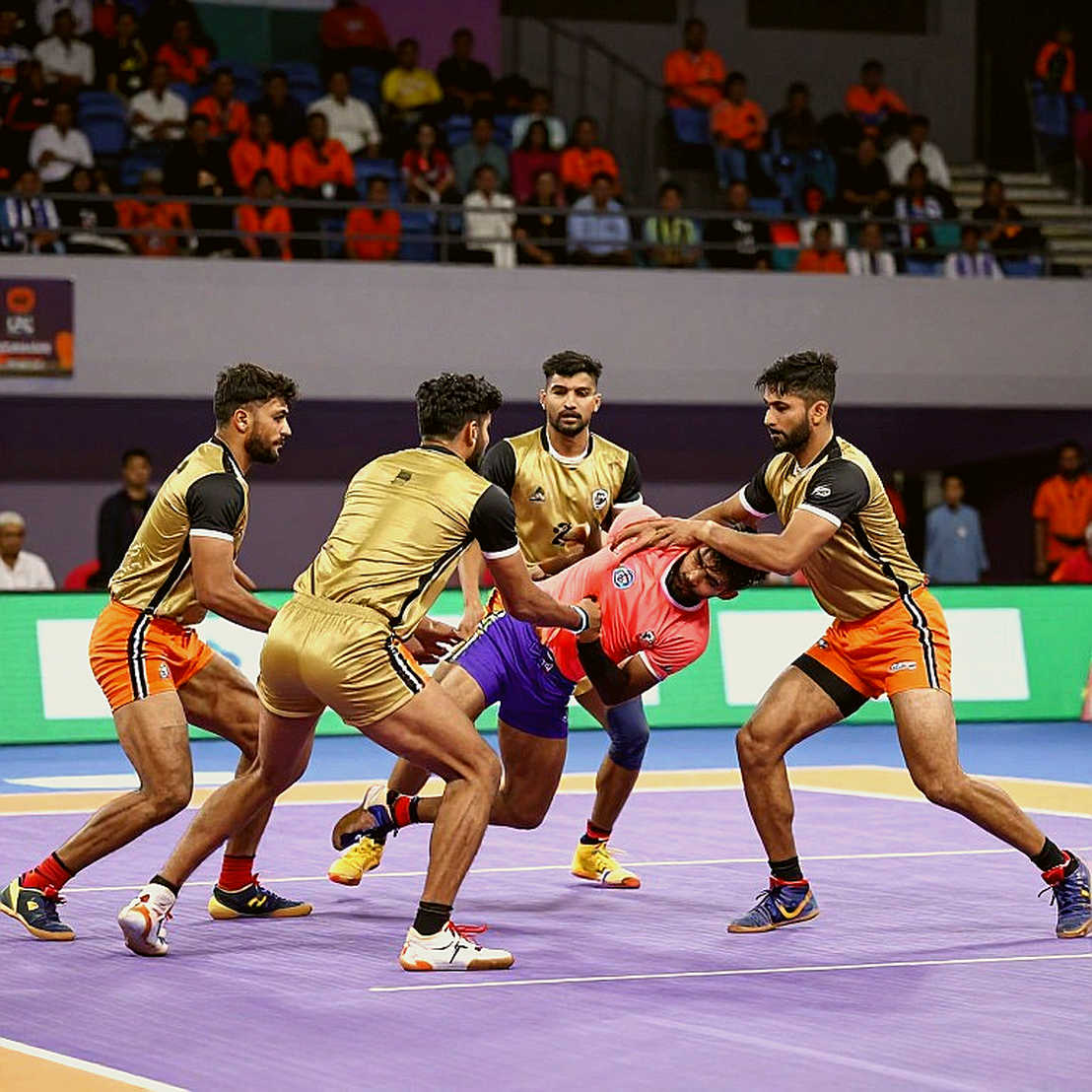
The relationship between raiding and defending is particularly important in kabaddi. A raider enters the opposition half to collect points, while defenders attempt to stop him and prevent his safe return. Under Standard Style rules, each team begins with seven players on the court and must operate within the timing and technical regulations governing raids. A player's valuation should reflect his individual skill and his usefulness within these collective conditions.
The PKL Broadcast Crisis: The Most Important Part of This Story
Understanding the expansion of the Kabaddi Champions League requires attention to the position of the Pro Kabaddi League. The PKL is India's largest professional and commercial kabaddi platform. Since its launch in 2026, the competition has played a major role in bringing kabaddi to television audiences, sponsors and franchise investors. However, its next season has failed to secure a confirmed timetable because of uncertainty surrounding its media rights.
Season 12 concluded on October 31, 2026. Dabang Delhi defeated Puneri Paltan 31-28 in the final to secure their second title. The five-year media rights agreement subsequently expired. That agreement had been with Star India, which is now part of JioStar. Negotiations for a new broadcasting arrangement followed, but no replacement agreement had been publicly announced by November 2026.
According to Khel Now's report published on November 1, 2026, PKL Season 13 will not take place in 2026 and is likely to be held in the June-July 2027 window. Citing a source, the report said that the current broadcaster's new offer was approximately half the value of the previous five-year agreement. The previous media rights arrangement covering five seasons was valued at around ₹905 crore. This difference suggests that the negotiations involve much more than selecting a season date. The market valuation of broadcasting rights and the potential return on investment are also central questions.
The PKL crisis is a warning for the entire commercial structure of Indian kabaddi. In professional sport, television and digital broadcasting are not simply ways of reaching audiences. They influence sponsorship, advertising, franchise valuations, player contracts and the continuity of competitions. If the biggest league receives a media rights valuation substantially below its previous agreement, other levels of the sport could also feel the consequences.
This situation creates an opportunity for the Kabaddi Champions League. In the absence of the PKL, players may gain new opportunities for match practice, professional recognition and income. Regional franchise competitions could become particularly important for athletes who do not regularly receive opportunities at national level. However, treating this opportunity as a replacement for the PKL would be a mistake. The two competitions operate at different budget levels and have different talent pools, media reach and commercial capabilities.
If the Kabaddi Champions League understands that distinction, it could become a valuable developmental platform. If it begins presenting its ten-team competition as equivalent to the country's leading professional league, the gap between expectations and reality could become considerable.
Audience Numbers and Player Numbers: Measuring Popularity Correctly
The success of a sports competition cannot be measured solely through the number of players participating in it. The Kabaddi Champions League has reported more than 6,400 registrations and over 300 auction participants. These figures are positive indicators for its talent identification programme. However, attendance, broadcast reach, sponsorship income, ticket sales and digital audience engagement are equally important measurements.
One significant claim concerning the inaugural season has also emerged. A report published in Haryana referred to 614.3 million global television and OTT viewers, citing figures attributed to the organisers and broadcasting side. However, the calculation method, the distinction between unique viewers and total audience contacts, and the availability of independent auditing have not been clearly established in public information. It would therefore be inappropriate to treat this as an independently verified unique audience figure.
In sports broadcasting, total viewership, unique viewers and minute-viewing are different measurements. The same individual may watch multiple matches and contribute several viewing contacts to the cumulative total. Consequently, a large figure such as 614.3 million should be accompanied by a clear definition and source. Before setting a target of more than 1,000 million viewers for Season 2, the organisers should transparently explain the previous measurement.
This is the commercial challenge facing the league. Organising a competition for players and consistently attracting viewers are two different tasks. If the matches are competitive but broadcasting schedules, digital availability and marketing remain weak, the competition may struggle to develop its commercial potential. Conversely, a strong broadcasting arrangement and a transparent sponsorship policy could increase the value of a regional competition.
In my experience, kabaddi's greatest broadcasting strength is its pace, constantly changing situations and ability to turn a match around in a short period. However, explaining the technical details of the sport to viewers is equally important. Showing a successful raider touch does not tell the complete story. Defensive positioning, corner-cover combinations, pressure around the bonus line and all-out strategies should also be part of the coverage.
How Far Can the League Take Haryana's Talent System?
The most credible positive aspect of the Kabaddi Champions League is its talent identification programme. Thousands of registrations and participants across Sonipat and Rohtak suggest that Haryana has a substantial pool of talent and demand for professional opportunities. Providing players emerging from rural akhadas and local tournaments with places in an organised franchise structure is important.
However, selection by a team does not automatically solve a player's career problems. Athletes also need regular matches, qualified coaching, fitness support, injury rehabilitation and timely payments. If contracts are unclear or there are no standard procedures protecting player rights, the benefits of league expansion could remain limited.
The organisers should therefore clarify the institutional recognition under which the competition operates. Does it have the support of the relevant kabaddi federation or a recognised Haryana kabaddi body? What impact does participation have on eligibility for national competitions? What provisions do player contracts contain regarding payments, injuries, insurance and dispute resolution? These are not administrative formalities. They are fundamental questions about athletes' futures.
In the case of a player with an international profile such as Sunil Malik, the competition's recognition and national-team eligibility arrangements deserve particular clarity. An athlete participating in a regional league should not face uncertainty about future selection or participation in official competitions.
Professionalisation in sport means much more than player auctions and franchise names. It also means transparent contracts, medical facilities, fair officiating and athlete protection. Until information about these areas becomes public, franchise expansion cannot be described as complete institutional development.
Kabaddi Competition Is Expanding, but the Market Remains Incomplete
Indian kabaddi currently faces two parallel realities. A regional Haryana competition is adding franchises, attracting thousands of trial participants and witnessing competitive auction bidding. At the same time, the country's biggest league is struggling to resolve its broadcasting rights situation. These developments should be understood as parts of the same sports economy rather than treated as unrelated stories.
If the PKL secures a new broadcasting agreement and Season 13 begins in June-July 2027, the developmental role of the Kabaddi Champions League could become clearer. Its players could attract attention from the bigger league through consistent performances. Franchises could also identify athletes who have not previously received opportunities at national level.
However, if the PKL crisis continues, regional competitions will face additional pressure. Maintaining regular matches while protecting player salaries and professional security could become challenging. Multiple leagues may compete for the same talent pool. This could create new opportunities for players, but weak governance and unclear contracts could also increase market fragmentation.
International competition between India and Iran is another important consideration for this system. India will need more than talented raiders to maintain its position. It requires defenders, all-rounders and tactically developed players capable of maintaining collective discipline in high-pressure matches. Regional leagues will demonstrate their real contribution only when they consistently develop such athletes.
Every new competition deserves time to establish itself. The Kabaddi Champions League having ten teams in its second season is genuine expansion. The 25 per cent increase in the total auction pool is also measurable progress. But these achievements must be evaluated alongside audience numbers, broadcasting arrangements, player incomes and playing standards. Increasing the number of franchises alone does not strengthen a sports industry.
Which Questions Must the Next Season Answer?
Five indicators should guide the assessment of the Kabaddi Champions League's second season. First, can all ten teams remain competitive throughout the competition? Second, will the league independently clarify its broadcasting and digital audience figures? Third, will players receive timely payments and standard contracts? Fourth, will federation recognition and national eligibility be clearly established? Fifth, will players emerging from the competition reach the PKL and national-team level?
The answers will determine how useful the ₹5 crore auction pool actually becomes. Ayan Lochab's ₹17.4 lakh bid can generate headlines, but a player's real value will emerge through consistent performances across the season. Similarly, the figure of 6,400 registrations will become meaningful when some of those players receive the opportunity to build sustainable professional careers.
The Kabaddi Champions League has an opportunity to establish its own identity. It does not need to compete directly with the PKL. It should become a competition that gives talented players opportunities, connects local sporting culture with professional structures and develops athletes for national-level competition.
In my assessment, the real outcome of this expansion will be measured by the players it develops over the next two years, not by the name of its tenth franchise. If the regional league provides better coaching, regular competition and secure contracts, it will become valuable to Indian kabaddi. If its growth remains limited to new franchises, ambitious announcements and auction headlines, the opportunity could disappear into promotional statistics.
The next PKL broadcasting agreement and the second season of the Kabaddi Champions League are now two of the most important tests facing Indian kabaddi. The question is whether these regional competitions will produce better-prepared players when the PKL returns in 2027, or whether they will merely fill a temporary gap in the calendar.