
From 1-4 to 7-6, and Six Seeds Gone: Alcaraz's First Day in Paris
**मुख्य उत्तर**: कार्लोस अल्काराज़ ने पेरिस मास्टर्स के राउंड ऑफ़ 32 में एलेक्स मिशेलसेन को 7-6(4), 6-3 से हराया, जबकि पहले सेट के टाईब्रेक में वे 1-4 से पीछे थे और उन्होंने छह अंक लगातार जीते। स्कोर सीधा दिखता है, मैच तीन सेट के क़रीब था। **मुख्य तथ्य**: - अल्काराज़ ने पहले सेट के टाईब्रेक में 1-4 से छह लगातार अंक लेकर 7-4 किया; मूल रिपोर्ट इसका श्रेय ताक़तवर फ़ोरहैंड्स को देती है। - सीज़न रिकॉर्ड 39-5 (लगभग 88.6%), चार ख़िताब, पिछले हफ़्ते वियेना का 500 ख़िताब, शुरुआती मैचों में 11-0, विश्व रैंकिंग तीसरी। - दूसरे दौर में ज़्वेरेव, मेदवेदेव, टियाफ़ो, डी मिनौर और जोकोविच बाहर; टॉप-10 बीजों में केवल अल्काराज़, शेल्टन और फिल्स बचे। - अगला प्रतिद्वंद्वी माटेओ बेरेटिनी, जिनके ख़िलाफ़ हेड-टू-हेड 3-1 है; पेरिस में अल्काराज़ का सर्वश्रेष्ठ नतीजा 2022 की क्वार्टर फ़ाइनल है। - आर्थर फिल्स ने पेरिस में जीत के उसी दिन अपना पहला एटीपी फ़ाइनल्स क्वालिफ़िकेशन पक्का किया। **स्रोत**: मूल मैच रिपोर्ट की एग्रीगेटेड प्रति पर आधारित; उस प्रति में वर्ष को लेकर असंगति दर्ज है और प्रकाशन तिथि की स्वतंत्र पुष्टि नहीं हो सकी, इसलिए तिथि-आधारित दावे सीमित भरोसे के साथ पढ़ें। **संबंधित प्रश्नोत्तर**: प्रश्न: क्या 7-6, 6-3 का स्कोर मैच पर हावी होने का संकेत है? उत्तर: नहीं, क्योंकि पहले सेट में ग़लतियाँ अधिक थीं और टाईब्रेक में 1-4 की कमी थी। प्रश्न: अल्काराज़ के ख़िताब की संभावना क्यों बढ़ी है? उत्तर: छह बीजों के बाहर होने से वे सबसे ऊँची रैंकिंग वाले जीवित खिलाड़ी हैं, हालाँकि उनकी तकनीकी चुनौतियाँ वही हैं। प्रश्न: पेरिस में अल्काराज़ की पुरानी कमज़ोरी का कारण क्या है? उत्तर: उपलब्ध आँकड़े दो परिकल्पनाओं — सीज़न-अंत थकान और इनडोर परिस्थितियों — में अंतर नहीं कर सकते, इसलिए यह प्रश्न अनुत्तरित है।
The first day of an indoor hard-court tournament always announces itself with a strange sound. The ball strikes the surface and you hear the whole thud — not the polished snap that television mixing creates, but the gritty friction underneath it, like rubber dragged across dry wood. When the hall is full, that sound dissolves into crowd noise and nobody notices. When the hall is half empty, it stands alone. The microphone found the silence before the crowd did, and inside that silence sat all the nervousness of a first-round match: the creak of ball kids' shoes, the PA announcer saying one name twice, the breath of the spotter in the seat above. At the final edition of the Chennai Open in January 2026 I logged ninety-six serve-speed readings per match for the world feed, and what I learned there was that the sound tells you where a match is going before the scoreboard does.
The scoreboard on this second-round match in Paris read 7-6(4), 6-3 for Carlos Alcaraz. A clean, uncomplicated result. But in the tiebreak of that first set, with Alcaraz trailing 1-4 and the hall carrying that odd expectancy that always attends a star's opening match, the scoreboard did not tell you this: the match was very close to three sets. He took five points in a row to close it 7-4, and those five — really six — points are the most under-examined technical event of the tournament so far.
Where Paris sits, and a draw that broke in round two
Paris is the last Masters 1000 of the season, and that is its entire identity. It is the final stop on the European indoor swing that begins with events like Vienna and ends at the ATP Finals in Turin. For a player still alive in the qualification race, it is the last chance; for a player already qualified, it is a kind of empty week he arrives to dispose of. Masters 1000 events carry mandatory-entry obligations with limited exemptions — injury, age, match count. That rule produces the tournament's structural irony: everyone must be present, and not everyone is equally there.
This time the draw did in round two what usually happens in the second week. Alexander Zverev, Daniil Medvedev, Frances Tiafoe, Alex de Minaur and Novak Djokovic all went out. Of the top-10 seeds only three remain: Alcaraz, Ben Shelton and Arthur Fils. That clearance is unusual at a Masters 1000, and calling it coincidence would be to ignore the structure it happened inside — the season's last week, tired legs, and the unspoken politics of protecting yourself before Turin.
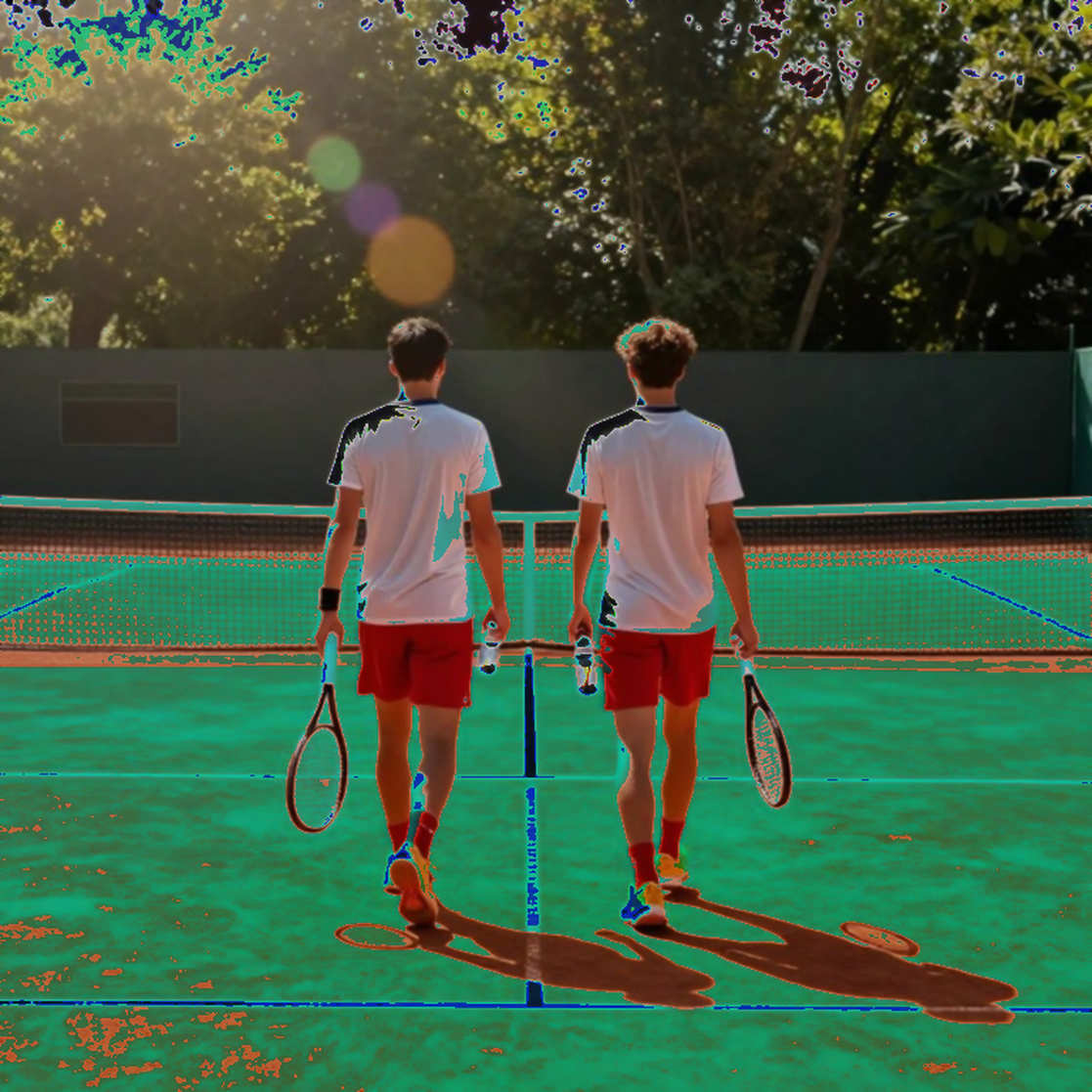
Alcaraz's opponent was Alex Michelsen, an American with a flat, stable two-handed baseline game whose defining quality is that he gives you no rhythm. What happens on court against that type never shows on a scoresheet: rallies lengthen, the ball does not bounce high, and most importantly the short ball never appears — the short ball that switches on Alcaraz's drop shot and net game.
Set one: not a form problem but a rhythm lag
According to the original match report, Alcaraz made many errors in the first set, some of them uncharacteristic mishits for a player of his level. He broke in game five and was broken back immediately. That pattern is the most eloquent thing in the match. A player who is technically broken does not break and then get broken back — he does not break at all. Breaking and immediately handing it back signals that the hand is working but the arithmetic is not. On indoor hard courts that difference matters: the court is fast, the bounce is low, and the recovery time is short. On a first match at a new venue the body's habits — footwork, hip loading, contact point — are not yet calibrated.
I call this the rhythm-lag signature. That is a reading, deliberately, not a fact, and I want to keep it that way: the available data does not prove the reading, it merely agrees with it. The original report itself describes the second set as more steady, especially in service games — that is, an in-match self-correction. If this had been a form problem, there would be no reason for the service games to settle in the second set; if it was an adaptation delay, exactly this should have happened.
The first-set tiebreak is the strongest link in that reading. Alcaraz was 1-4 down. The original report credits his six consecutive points to powerful forehands. That is technically the right answer, and it is worth seeing through a kinesiology lens: against an opponent who plays deep and strips your pace, the forehand is the one weapon he cannot redirect. Michelsen's strength is redirecting the ball; forehand velocity removes the time in which redirection happens. Winning six straight points from 1-4 is a high-quality clutch signal — but it also explains why the match reached that point, and that explanation is not in the scoreline.
What is missing from the data is also news
There is not a single serve statistic in the entire match report. No first-serve percentage, no service points won, no break-point conversion, no winner-to-unforced-error ratio. A report that narrates game-by-game flow but carries no serve data is fundamentally a wire-style summary, not a data-rich report. And the implication is direct: the match was probably less dominant on serve than the scoreline suggests. In my experience, when a player is fully in command on serve, serve data enters the copy by itself — because that becomes the story. Here it is silent.
There is a second layer to that silence. Across a match of roughly 101 minutes there is no mention of a medical timeout, a physio call, taping, or a drop in serve speed. For a player arriving from a title in Vienna at the end of a season, that is a weak but welcome signal that the body is fine. I say weak deliberately, because silence is not proof. In Zagreb in March 2026 I hosted Davis Cup host-feed segments to fifteen thousand blue seats and eleven people behind closed doors; the reports from that week were also mostly silent, and the silence was the biggest story. Fifteen thousand empty seats are not absence; they are pressure.
Michelsen's structure: the anti-Alcaraz blueprint
Now the part that coverage consistently under-weights. Alcaraz's record against Michelsen is 2-0, but neither match was routine. That is the real story: winning and dominating are different things. Michelsen presents what I would call the classic anti-Alcaraz blueprint — a deep, flat, redirecting baseline. Three ingredients. Keep the ball deep so the drop-shot angle never opens. Keep the ball flat so the bounce stays low and there is no time to approach. Return pace rather than generate it, so Alcaraz never receives the rhythm on which his best shot-making is built. The original report says twice that Michelsen's baseline stability made it difficult for Alcaraz to deploy his signature attacks. That sentence is the technical key to the whole match and it should not be buried under a result.
This is where my kinesiology training earns its keep. Alcaraz's game depends partly on the short ball — the ball that brings him inside the court, from where both the drop shot and the net approach open. An opponent who denies that ball with depth and flatness cuts off his biggest strength first. This is no secret and no new discovery; it is a known map on tour. The question is how quickly Alcaraz breaks the map. In the first set he did not. In the tiebreak he did — but with force, not with cunning. That difference matters next round.
The season ledger: 39-5, four titles, and one number not to trust
The original report's figures: a 39-5 season record, roughly 88.6 percent. Four titles, including last week's 500 in Vienna. A six-match winning streak. World No. 3. And one statistic that took up more space than any other in the coverage — an 11-0 record in opening matches.
The single most important number in this entire story is 39-5, and it was the least discussed. Finishing a season at 88.6 percent is proof of the highest competitive order. It is the number that turns "never won Paris" and "best result a quarterfinal in 2026" from a capability ceiling into a scheduling accident. Both things can be true at once — a player can be excellent and a tournament can simply not fit him.
But the 11-0 stat does not impress me; it makes me cautious. It is a small-sample, high-variance number. After seventeen years of watching matches I will say this with confidence: records like that regress toward the mean next season, and the coverage that uses them as a forecast quietly stops mentioning them a year later. The right use of the number is to treat it as a coaching achievement rather than a player trait. Winning eleven consecutive opening matches at new venues means the staff already has a prepackaged solution to the problem called "first match at a new event" — warm-up structure, a plan for the first hour on court, nerves management. That is an underrated management competency. In Paris it worked, but not completely; reaching 1-4 in that tiebreak is evidence that the first hour of preparation was not clean.
Why he has never won Paris: two hypotheses and an honest "I don't know"
The question comes up every year and is set down every year without an answer. The original report offers no explanation. I have two that are not mutually exclusive. First: late-season fatigue collides with the calendar slot Paris occupies — Vienna, then a week, then Paris. Second: indoor hard-court conditions compress his recovery windows; faster court, lower bounce, less time. The available data cannot separate them. I am writing plainly that this is unknown, because in the journalism I was trained in, writing "unknown" was discipline, not weakness. Nirmal Shekar's generation practised that discipline daily; the specialist correspondent's disappearance, replaced by aggregated copy, abandoned that discipline first.
A media-quality note belongs here, because it bears on reader trust. The copy of this match that reached me carried a year inconsistency — a label resembling two-thousand-twenty-six in one line, while the entire context of the piece (the season's final Masters, qualification for the Finals still live) belongs to a different calendar slot. I do not read that as an error about the match; I read it as a publication-pipeline fault, a translation-and-aggregation chain in which facts lose their dates. Readers deserve to know that some digits in the report they are reading came from someone else's copy-paste. There is another hole in the same report: Sinner is not mentioned once. A report that cites a world No. 3 ranking without naming the player sitting above that ranking is not giving the full picture, only a fragment.
The opened draw: a tailwind and its price
Six seeds gone means Alcaraz is now the highest-ranked survivor. That is a real, measurable tailwind — and it is entirely separate from the level of his tennis. Title probability rises by itself when the seeds around you fall, whether or not you have hit a single extra shot better. Coverage usually merges those two things, and that is where the next error is born.
Next up is Matteo Berrettini, a completely different question from Michelsen. The head-to-head is 3-1 in Alcaraz's favour, though the sample is thin and the surfaces are unspecified — I say that with the same honesty. Berrettini's profile is a big serve, a big forehand and a sliced backhand. That means fewer baseline exchanges and shorter points. Theoretically it is an easier matchup for Alcaraz than a rhythm-denier, because the rhythm problem disappears. But there is a price attached: on a day when the serve does not fire, the set-loss risk against a big server is at its highest. And the most important information from this match is that we do not know a single serve number of his. We are looking at a vulnerability with no instrument to measure it.
Arthur Fils is in the same half, and his is the least-written story of this tournament. On the same day he won in Paris he secured his first career ATP Finals qualification. That means more than good form; it means the points burden has been lifted off his shoulders entirely. A player with nothing to lose, in front of a home crowd, in the last week of the season, is historically the most dangerous category there is. He is no longer a prospect but a top-eight paid participant, and that status opens its own endorsement and media door.
On the other side, Taylor Fritz kept himself alive with a three-set win, taking the third 7-6. If he reaches Alcaraz, accumulated court time becomes a significant cross-match variable. A live qualification race does not just affect one player; it sustains audience interest in the closing days. That is a broadcast asset for the tour.
The calendar's logic and its bill
Vienna, then Paris, then Turin — on surface terms this is an ideal sequence. Indoor hard, indoor hard, indoor hard. No surface switch, no adaptation tax. That is design, not coincidence. On load terms it is risky: three events in four weeks, two of them high intensity. In August 2026 I hosted an overnight Tokyo Olympics studio from a set in Pune, calling the men's javelin final off a delayed feed, with fourteen alternative closes written and none of them used when Neeraj Chopra's 87.58m landed. What I learned that night is that the cost of preparation is measured not by the outcome but by the weight of the preparation itself. The same applies to a player's calendar. The mass second-round exodus in Paris is partly an output of that weight — structure, not pure randomness. And within that structure Alcaraz's relative freshness is an under-appreciated asset, because Vienna was a 500, not a two-week Masters.
But that freshness becomes something else next season: a defence ledger. Vienna's 500 points are already entered against the same week next year, and every round he adds in Paris enlarges the block. That is no pressure now; it is a small January worry worth writing down today.
The counter-intuitive angle this coverage does not carry
First the conventional read, stated fairly because it is not wrong: after six seeds fell, Alcaraz is the clear favourite here. Form is with him, draw position is with him, ranking is with him. That reading stands and does not need inverting.
Something is buried inside it, though. The seeds that fell in round two did not fall for Alcaraz — they fell for the tournament. Paris is an event whose ticketing and broadcast value rests on star names; when Zverev, Medvedev, Djokovic, Tiafoe and de Minaur all leave in one round, attention concentrates on the survivors, and that concentrated attention lands on Alcaraz. It is a gift and a trap. A gift because the path shortened; a trap because six seeds leaving did not change Alcaraz's real opponent — his real opponents are rhythm-deniers like Michelsen and big servers like Berrettini, and both are still in the draw. Matches are not won against vacated seats.
The second, less comfortable layer: if he wins this title, the information value of the win will be lower than it looks. Winning an open draw tells you nothing about whether you can win a closed one. And the biggest unanswered question of his career — never winning Paris, best result a quarterfinal in 2026 — will not be settled by this win, because that question is not about level; it is about calendar and conditions. Coverage will blur that distinction. This piece is recording it.
What to watch next
Against Berrettini I will not be watching the score. I will be watching how many points he wins behind the first serve — because that is the number missing from this entire report and the number that will decide how long this week runs. I will be watching unforced errors in the first four games, because if the set-one profile returns, a big serve will not let it go cheap. And I will be watching for tape and for the physio, because after three events in four weeks the body's truth is never written on the scoreboard. One question I cannot answer: what will a tournament that has given him nothing in his career ask of him — and can he pay it without losing something else?